Thursday, September 29, 2011

Other artist statements

Phil Hansen
 Che, acrylic on paper, 2006

I’m interested in trying to understand whole individuals and whole ideas through the fragments
of perceptual memory, the sound bites, and the semiotic tokens collected by society and
recollected by the individual. It’s the product of these carefully selected elements that
multiplies out to a greater whole, and it’s in that product that I look for a more holistic
understanding.

My present approach evolved out of what seemed at the time to be an artistic cul-de-sac:
damage to the nerves in my forearm from the single-minded pursuit of pointillism. Forced to
think of other ways to create art, I began pushing myself to experiment with new mediums: my
torso, a tricycle, X-rays, dandelions, the Bible, key phrases out of audience stories, and so
on. The selection of the medium became integral to the art, as much a part of the story and
the holistic experience as the selected fragments themselves.

In bringing my work to the public I look to create a public dialog with art, frequently inviting the
audience to contribute in some way, nearly always breaking apart the artistic process in order
to make it connect to a more immediate reality through video that shows manipulation of the
medium from fragments into a unified whole. It’s far from a didactic endeavor: I draw
inspiration from my collaborators’ experiences as much as they discover art through my work.


Michael Reedy 
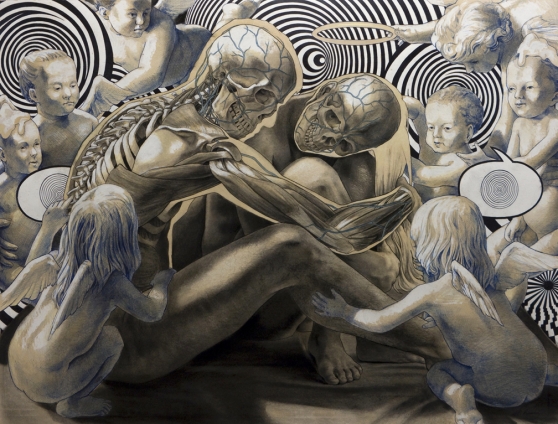
don't worry baby, mixed media on paper
The human figure and portraiture have been central to my studies and explorations as a practicing artist for the past twelve years. In a desire to extend beyond historical modes of representation, I have found myself increasingly interested in depictions of the body that fall outside the canon of art history, namely in cartooning and medical illustration. Ultimately, I believe that by combining the visual language and style employed by various modes of representation, both inside and outside the accepted boundaries of fine art, I can locate and capitalize on unique areas of resistance essential to the production of new meaning.

Thursday, September 22, 2011

Week 4 - Themes and Theory

A couple weeks ago we discussed an article on "mechanical reproduction" of art. Now, given the fact that the article was written in 1935 and a bit has changed since then, I found myself taking what it said with a grain of salt. I mean, the article is actually older than my dad, and that's saying something. Photography and film, the article's main foci, are hardly the same as that they were in 1935. And especially mechanical reproduction, that is, duplication of a work via mechanized process such as film/photocopying, has completely blown up now in the digital age. To reproduce a piece is simply the work of a single click of a mouse in most cases. In fact, reproduction of art is so ingrained in our society, the idea of a singular piece of work or the value of the original is extremely diminished. Why go see the real Last Supper when I can look it up online? Why should I go look at original Escher prints when every college student with access to a poster sale has them up in his or her dorm? Why would I go to the premier of a movie when I can see it in any theater in America, or better yet why even leave my house when I can download it straight to my computer?

The key factor here is that this effect of "de-valuing the original" does not actually take away any worth of the original product, but removes the need for a full on pilgrimage to see it. Sure, some people find it their life's calling to go see the actual Mona Lisa in the Louvre, but for those of us who cant afford the thousands of dollars to go to Paris, mechanical reproduction is an amazing thing.
Also, with photography and film, their mechanical reproduction steers us to the concept that the singularity of a work does not have to directly relate to its value.

And that is how this concept most relates to my own work. With makeup art in film, the actual makeup itself and its use are almost two separate things. In a sense, I could do a makeup on someone as a stand-alone piece without the context of a movie. But then that's just body art. Not to discredit that, but for me it's context, its actual use and appearance in a film, that makes the makeup special. And then to have that work reproduced across the country, or even the world, is an amazing thing.
I want my work to be mechanically reproduced, because the effect of mechanical reproduction today is immortalization. Paint flakes off, latex deteriorates, foam prosthetics deflate, and silicone peels off. No makeup is permanent. Even the skin rejects it, as it regenerates underneath, pushing this external substance away from it. My work will not last 600 years like an oil painting, or 2000 like a marble statue. But in a movie it will be fresh forever.

Thursday, September 15, 2011

Artist Statement (edited again)

Hold Still, self-portrait, conte on paper, 24"x18" 2010

Most people will sit through an entire film completely unconscious of the fact that all the wounds, mutations, aliens, and creatures they just witnessed were all fabricated. They suspend their disbelief while watching, and they leave the theater knowing that Jared Leto didn't actually have to walk around with his face smashed in after filming Fight Club and that Ralph Fiennes (Voldemort) actually has a nose. What people frequently forget is that behind every swollen black eye, severed limb, and oozing wound is an artist creating that illusion, and each effect is their masterpiece.
For me, the greatest inspiration behind makeup art is the human body as a canvas. To recreate the human body in paint on a canvas is one thing, but to create a work directly on the varied surface of skin is a whole new dimension. You can build upon the human form, using the skin as a foundation.     However, my favorite aspect of makeup art, and my focus in the area, is bringing the inside to the outside. More specifically, the representation of internal structure externally. What it comes down to is my deep fascination with the structure of the human body. In all of nature, to me the human body is the most beautiful and complex structure on the planet. We are such intricately designed creatures that every inch of our structure, down to every cell, is a miracle, regardless of whether you believe in intelligent design or not. Too often is our amazing composition taken for granted. 
     My work is not symbolic. I strive to make it representative because it is a devotion. It is a tribute to the human form. When you are creating a work on a person, there is a connection both to the art and to the model. They are in your hands, and whether they are calm or nervous all you can tell them is "hold still."

Friday, September 9, 2011

Soooooo my style

Found this just now on Pinterest and had to post it on here. (literally everything about this sentence makes me cringe) 


Its a painting by an artist named Michael Reedy, titled 69, possibly 80. Upon further research, I found his website and I'm just DROOLING over how applicable his art is to my thesis project. Here's a link to images of his series on anatomy, which the above painting is from. Totally. Loving. Everything.

Thursday, September 8, 2011

3 Artists

Walton Ford
Working primarily in watercolors and ink prints, Ford creates parodies of Audubon illustrations that reveal the darker side of nature. While his images at first glance are simply beautiful natural representations, upon closer look, you will find scenes of nature at its worst.
The image above depicts a type of bird that migrates in flocks of such great number that when they land, their weight can cause branches and even entire trees to fall.

Graeme Base
While predominantly a children's book author, Base's illustrations can stand alone as fantastical works of art. His style is whimsical and intricately detailed, and his eye for composition give each image immense depth.
The above image is from Base's book The Discovery of Dragons.

Mike Lewis "The Jesus Painter"
While many artists who deal solely in religious iconography are considered cliche, some actually can find a niche that makes them exemplary. Mike Lewis holds his ground by creating emotionally evocative speed performance paintings depicting Jesus, earning him the moniker "The Jesus Painter". He travels around the country doing these performance works, which are large scale paintings done usually in less than 10 minutes. Their high contrast style, pops of color, and iconic imagery is what makes them some of my favorites.